Fraud Gauntlet

Fraud Gauntlet

Project Type

HackathonsWeb DevTools
14
Technologies
13
Features

Overview

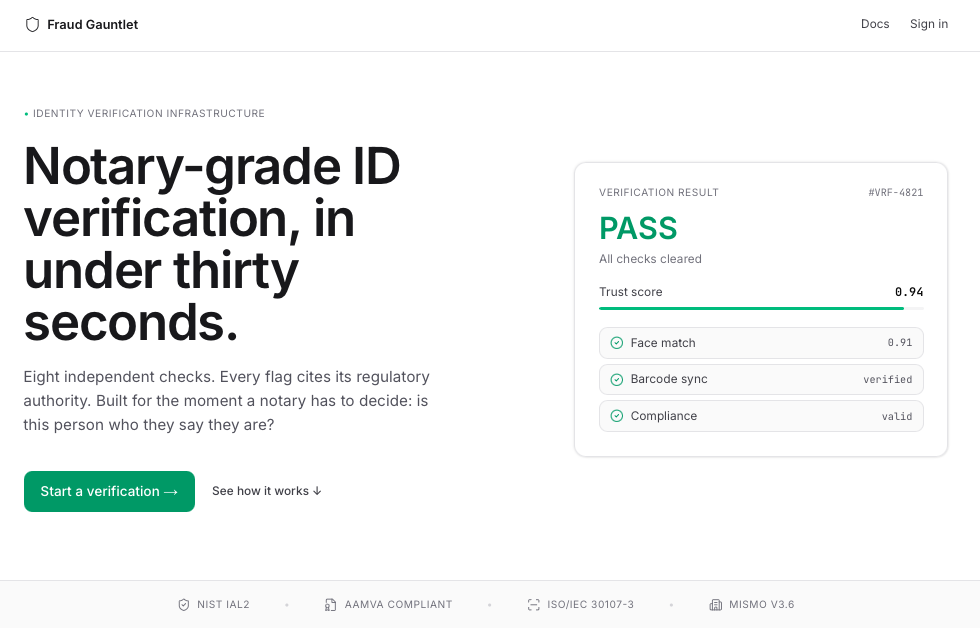
A tiered eKYC and identity verification pipeline for Remote Online Notarization (RON), targeting NIST SP 800-63A IAL2 assurance. Built for the Notary Everyday x VillageHacks 2026 'ID Verify AI' challenge. 1st Place winner.

Key Features

Liveness detection via MediaPipe Face Mesh with active challenges (blink, head pose, smile) and passive depth cues to defeat replay and deepfake attacks
1:1 biometric face matching between selfie and ID portrait using DeepFace (FaceNet, ArcFace, VGG-Face)
PaddleOCR field extraction from the front of the credential, tolerant to glare and occlusion
AAMVA PDF417 barcode decoding treated as the canonical identity source (DAC, DCS, DBB, DAQ, DBA, DAG, DCF)
Barcode-vs-OCR cross-check to surface field-level forgery signals
Document SDK verification against 5,000+ templates with MRZ parsing via Doubango KYC
Error Level Analysis (ELA) to surface digital tampering and recompression artifacts
Presentation Attack Detection trained on KID34K (34K labeled genuine vs. spoofed IDs), ISO/IEC 30107-3 compliant
Four-stage Claude API document pipeline: extract and classify, cross-document consistency, tampering detection, ID-to-document matching
Catches the Salone v. Stovall page-swap attack via field-level reconciliation rather than relying on PDF metadata
Statutory rule engine citing NIST IAL2, AAMVA, and state-specific ID requirements, with KBA escalation for ambiguous cases
Notary commission verification to catch complicit-notary fraud patterns
Tamper-evident audit trail with machine-readable JSON for every check

Tech Stack

Python
FastAPI
Pydantic
Next.js
React
Supabase
Claude API
DeepFace
MediaPipe
PaddleOCR
Doubango KYC SDK
EfficientNet-B0
ViT (timm)
ReportLab

Detailed Description

Fraud Gauntlet replaces the failure-prone 'notary squinting at a driver's license under bad lighting' with a layered forensic, biometric, and cross-document pipeline. It catches both physical credential fraud (counterfeit IDs, page-swap deeds) and presentation attacks (deepfakes, screen replay, print spoofs). A signer uploads their driver's license (front and back), a live selfie or video, and the associated loan package (Form 1003 URLA, Deed of Trust, etc.). The system runs an eight-check eKYC pipeline plus a four-stage document verification pipeline, then returns a structured, audit-ready verdict with per-check confidence scores, rule citations, and an IAL2 pass/fail determination suitable for inclusion in a MISMO v3.6-compliant closing package. Aligned with NIST SP 800-63A, ISO/IEC 30107-3, AAMVA DL/ID Card Design Standard 2025, MISMO v3.6, and CFPB TRID.